實戰文章
Eco Kraft Paper Bag: The Complete Guide to Custom Sustainable Packaging
eco kraft paper bag的優化重點,是先確認用途、內容物重量、尺寸比例、材質與加工,再決定提把、底部補強和交期安排。本文會帶你看規格判斷、詢價資料與常見風險,避免只看單一範例就決定量產方案。

What Is an Eco Kraft Paper Bag? (30-Second Answer)
eco kraft paper bag要先從實際用途判斷:內容物尺寸與重量決定袋身比例,通路情境決定紙材與提把,品牌視覺則影響印刷、燙金、霧膜或局部加工。先把這些條件列清楚,後續估價、打樣與量產才不容易反覆修改。
What makes kraft 'eco' isn't a certification label alone — it's the supply chain. Kraft pulp requires no chlorine bleaching (for unbleached grades) and far fewer chemical additives than coated paper. When sourced from FSC-certified forests, the entire lifecycle carries a dramatically lower carbon footprint versus virgin plastic or laminated alternatives.
For brands, the eco kraft paper bag also carries a visual language: natural brown texture, understated logo printing, and an inherent message of authenticity. That's why bakeries, organic food brands, artisan cosmetics, and zero-waste retailers all default to kraft as their primary carry bag.
如果你同時在找禮盒包裝方案,可以參考 rigid-box.net 精裝盒專站。
- No plastic lamination — fully recyclable and industrially compostable
- Unbleached kraft requires no chlorine — fewer chemicals in production
- FSC-certified supply chain available from 300 pcs MOQ
- Natural brown texture communicates authenticity and sustainability
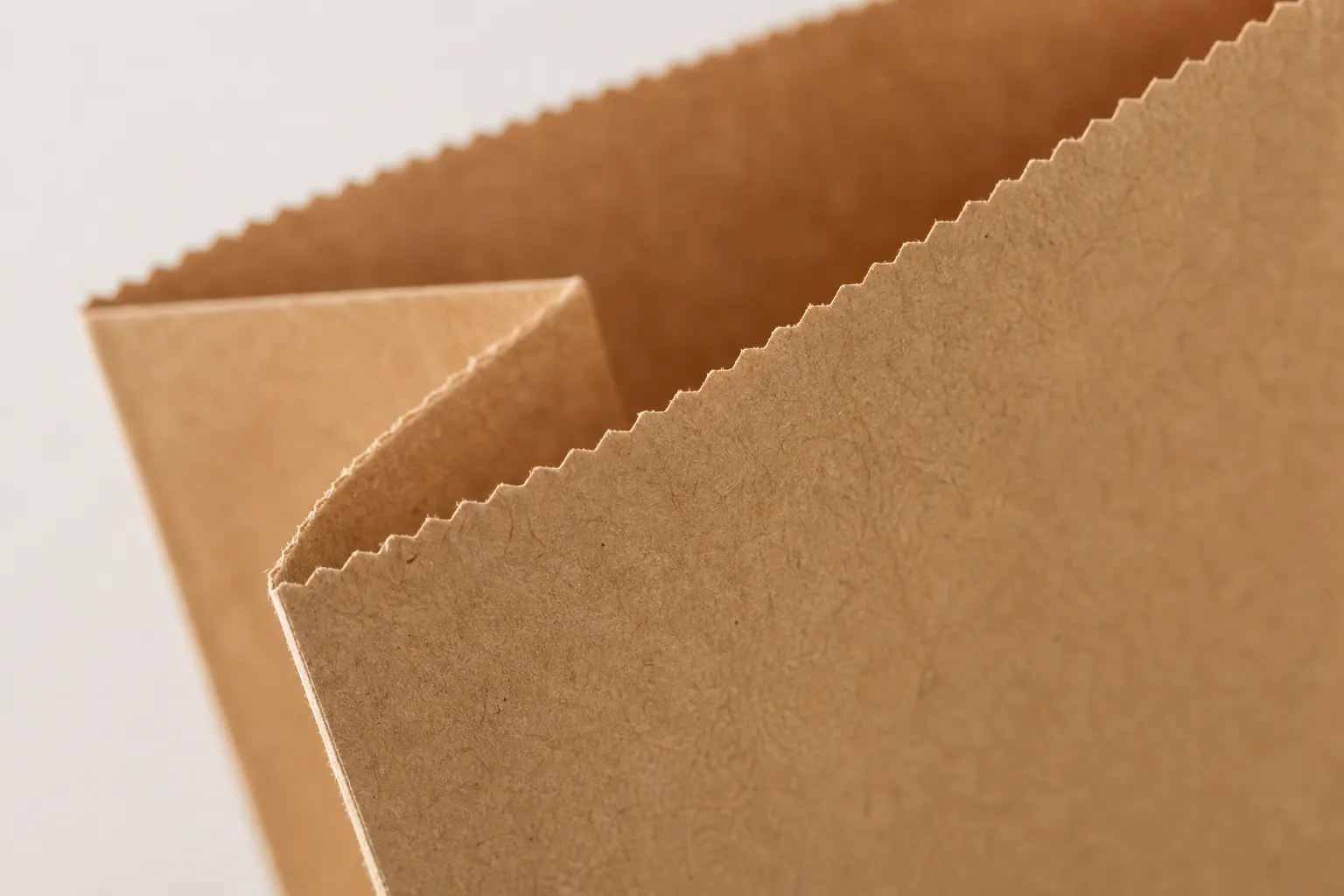
Unbleached vs White Kraft: Which Is More 'Eco'?
This is the most common sourcing confusion for buyers. Here's the direct comparison:
**Unbleached brown kraft** retains its natural amber-to-tan colour because the pulp skips the bleaching stage entirely. It uses fewer chemicals in production, which makes it marginally more eco-friendly at the manufacturing stage. The visual effect is raw, warm, and handcrafted — ideal for bakeries, organic food, and artisan brands.
**White kraft** (also called bleached kraft) undergoes an Elemental Chlorine Free (ECF) or Totally Chlorine Free (TCF) bleaching process. Modern TCF white kraft has a very small environmental gap versus unbleached, and both grades are fully recyclable and compostable. White kraft offers a cleaner printing surface — full-colour CMYK prints far more accurately on white than on brown.
**The honest verdict:** If your brand can work with the brown aesthetic, unbleached is the purest eco choice. If you need accurate colour reproduction or your brand palette relies on light tones, white kraft with TCF bleaching is an acceptable and still genuinely sustainable option.
Both grades are available with FSC-certified sourcing through our Taiwan factory — just specify at inquiry stage.
- Unbleached brown: no bleaching chemicals, warmest eco credential
- White kraft (TCF): chlorine-free process, suitable for full-colour printing
- Both grades recyclable curbside and industrially compostable
- FSC certification available for both — specify at inquiry
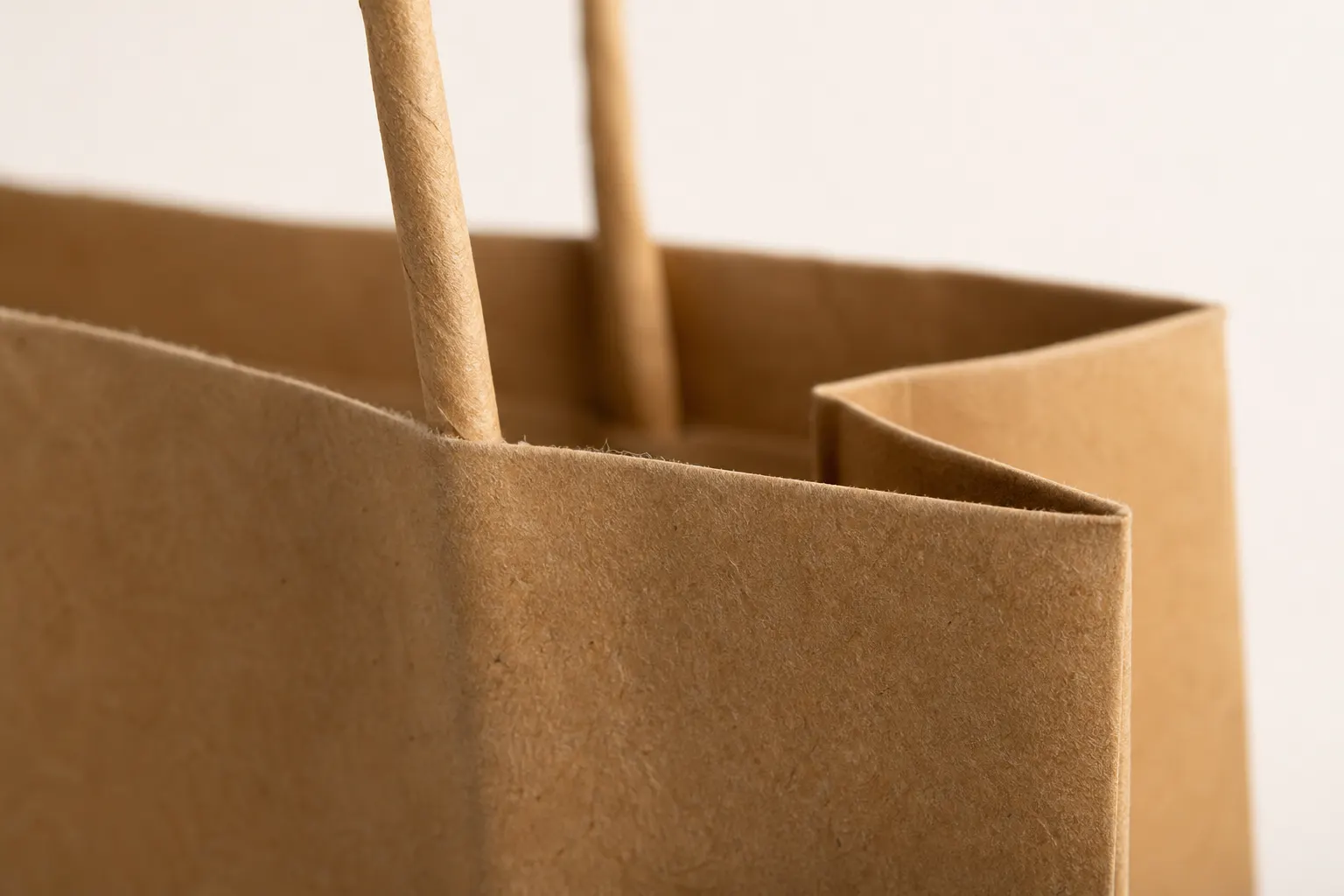
Eco Kraft Paper Bag Specifications: Weight, Size, and Handle Options
Getting the specifications right determines both the product's durability and its sustainability profile. Heavier bags use more fibre — but they also last longer and carry more, which can reduce total bag consumption per customer visit.
**Grammage (GSM)**
- 80–100 gsm: Lightweight, flexible. Ideal for small retail items, bakery single-item bags, and sachets. Lower material use per unit, but less structurally rigid.
- 120 gsm: The industry standard. Balances rigidity, print quality, and material cost. Handles loads up to approximately 4–5 kg depending on bag construction.
- 150 gsm: Premium feel, high rigidity. Suitable for wine, books, gift retail, or any product where the bag itself is part of the brand experience.
**Standard sizes (custom dimensions available)**
- Small: 18 × 8 × 22 cm (W×D×H) — cosmetics, bakery items
- Medium: 24 × 10 × 28 cm — general retail, fashion accessories
- Large: 32 × 12 × 36 cm — apparel, books, gifts
**Handle types**
- Twisted paper handle (most common, fully recyclable, recyclable in the same stream as the bag)
- Flat paper handle (cleaner look, slightly higher cost)
- Cotton cord handle (premium feel — note: requires separation at recycling stage)
For maximum eco compliance, twisted or flat paper handles keep the bag mono-material (all paper), which simplifies recycling for your end consumer.
- 120 gsm is the most popular all-purpose eco kraft weight
- 150 gsm for premium gifting or products requiring higher load capacity
- Twisted paper handles = fully mono-material, simplest recycling
- Cotton cord handles add premium feel but require handle separation to recycle
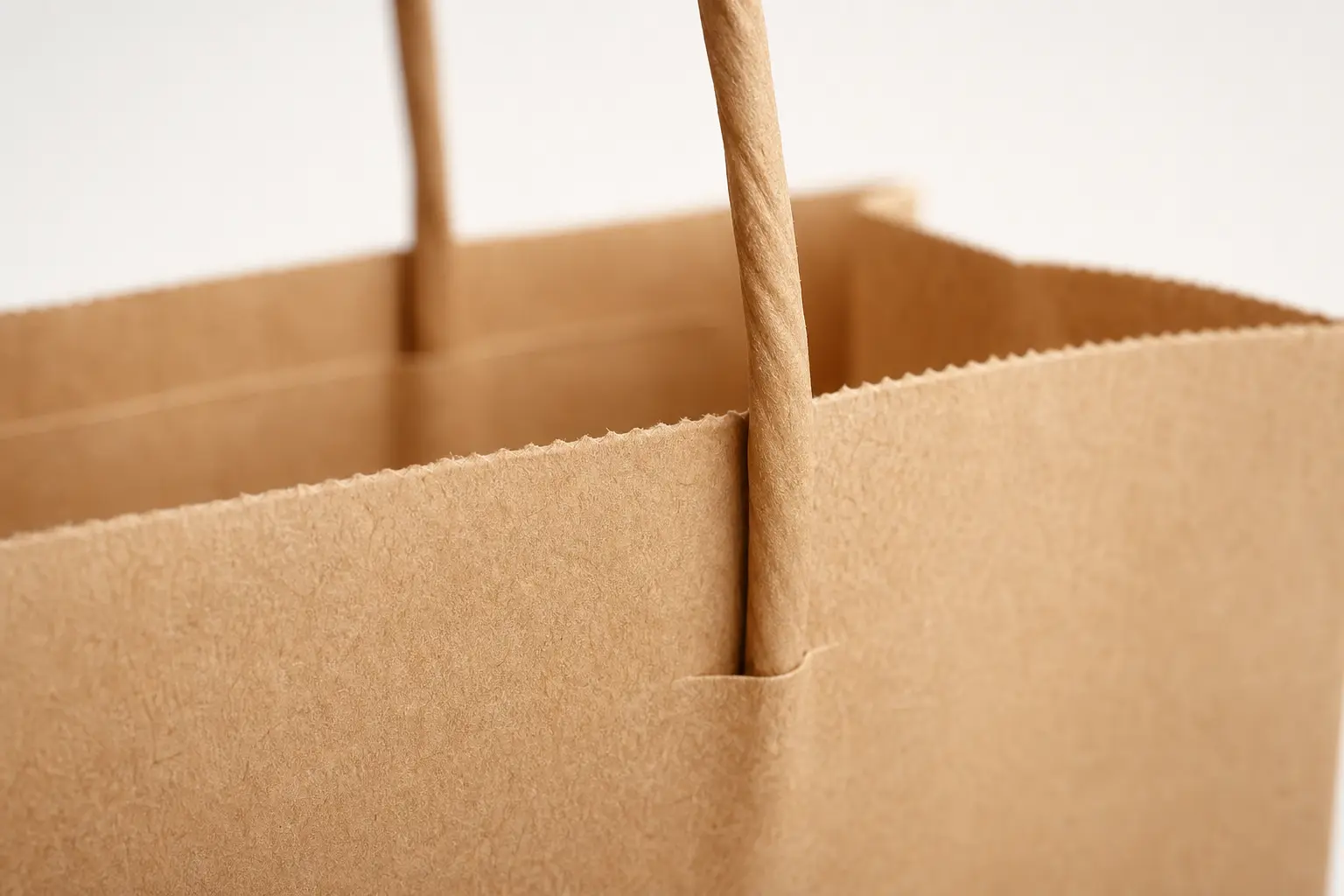
Printing on Eco Kraft Paper Bags: What Works, What Doesn't
Kraft paper's natural texture is its biggest design asset — and its biggest printing constraint. Understanding this upfront prevents costly production surprises.
**What works well on unbleached kraft:**
Single-colour or two-colour flexographic printing produces the cleanest results. Dark inks (black, deep navy, forest green, burgundy) contrast strongly against the brown base, creating clean, legible logos with excellent brand recall. Many successful eco brands use black ink only — the simplicity communicates confidence.
Hot foil stamping (gold or silver) on unbleached kraft creates a striking contrast — the metallic sheen against raw brown paper reads as artisan-meets-luxury. This is the most popular upgrade for organic skincare and premium food brands.
**What's more challenging:**
Full CMYK four-colour process printing on unbleached kraft will shift all colours toward warm/brown tones. Blues will look greenish, pinks will look terracotta. If your brand palette requires accurate colour reproduction, consider white kraft instead.
White ink on unbleached kraft requires an underbase coat (an extra print pass), adding approximately 15–20% to printing cost. The result is softer and more off-white than pure white — factor this into your design expectations.
**Colour shift reference (ΔE standard):** Our factory holds a ΔE ≤ 3 colour tolerance on kraft printing. If your brand colour requires tighter tolerance, specify a Pantone swatch at the inquiry stage and we'll advise on feasibility before accepting the order.
- Single/two-colour dark inks on kraft: cleanest, most reliable result
- Hot foil stamping: highest visual impact on unbleached kraft
- Full CMYK on unbleached kraft: colour shift toward warm tones is expected
- White ink requires underbase — softer white appearance, +15–20% cost
- ΔE ≤ 3 colour tolerance standard; Pantone specs welcome
FSC Certification: Why It Matters and How to Request It
FSC (Forest Stewardship Council) certification is the globally recognised standard for responsibly sourced paper. For eco kraft paper bags, FSC certification provides your customers and B2B buyers with verifiable proof that the paper fibre originates from forests managed for biodiversity, worker rights, and sustainable yield.
Many European and North American retail buyers now require FSC-certified packaging as a baseline procurement condition. Even without a legal mandate, FSC certification supports your brand's ESG reporting and sustainability claims — increasingly important for B2B supplier qualification and consumer trust.
**What FSC certification covers in your kraft bag order:**
- The paper itself carries FSC Chain-of-Custody from forest to mill to converter
- The finished bag can carry the FSC logo (subject to your own FSC licence or use of our certified logo under our licence)
- Documentation provided for your supplier audit files
**How to request:** Simply specify 'FSC-certified kraft' in your inquiry. There is a small material premium (typically 5–10% on paper cost, not total bag cost) for certified grades. Lead time is the same.
For more detail on FSC standards, see the FSC official website.
- FSC certification required by many EU/US retail buyers
- Supports ESG reporting and supplier qualification
- Chain-of-Custody documentation provided for your audit files
- Material premium typically 5–10% on paper cost
- Specify FSC at inquiry — no extra lead time required
MOQ, Lead Times, and Pricing Structure for Custom Eco Kraft Bags
Transparency on cost and timeline saves both sides time. Here's what to expect when ordering custom eco kraft paper bags from our Taiwan factory.
**Minimum Order Quantity (MOQ):**
- 300 pieces: minimum for single-colour custom printing
- 500 pieces: recommended for first orders (safety stock + sampling variance)
- 1,000+ pieces: significant unit cost reduction, priority production queue
**Lead Times:**
- Samples (1–3 bags): 7–10 business days after artwork approval
- Production order (standard): 15–20 business days after sample approval
- Rush production: 10–12 business days (surcharge applies, subject to capacity)
**Pricing structure (indicative, varies by spec):**
- Bag unit cost depends on size, GSM, and print complexity
- One-time plate/die costs are charged once; repeat orders use the same tooling
- Hot foil stamping: copper die fee (one-time) + per-unit foiling cost (typically +30–50% vs standard printing)
- FSC material premium: +5–10% on paper cost
We do not publish fixed prices because kraft bag pricing is highly spec-dependent. Contact us with your size, GSM, quantity, and print requirements for an accurate quote — typical quote turnaround is 1 business day.
- MOQ from 300 pcs for custom single-colour printing
- Standard production lead time: 15–20 business days after sample approval
- Plate/die tooling cost is one-time — repeat orders no re-tooling fee
- Quote turnaround: 1 business day with spec sheet
Which Brands Should Choose Eco Kraft Paper Bags?
Eco kraft paper bags are not the right fit for every brand — and choosing the wrong material undermines both sustainability and aesthetic goals. Here's an honest breakdown of best-fit and poor-fit scenarios.
**Best-fit brands:**
- **Bakeries and food producers**: The natural paper look signals freshness, handcraft, and food safety without any extra marketing effort. Greaseproof-lined kraft variants handle pastries and oily items well.
- **Organic and natural product brands**: Skincare, supplements, herbal teas, and wellness products all benefit from kraft's visual shorthand for 'clean, simple, no synthetics'.
- **Artisan and craft retail**: Ceramics, candles, leather goods, stationery — the tactile roughness of kraft aligns with handmade brand values.
- **Zero-waste and plastic-free retail**: Mono-material kraft bags with paper handles are the only carry bag option that requires zero sorting at consumer recycling.
- **Premium gifting with a sustainability angle**: 150gsm kraft + hot foil stamping achieves luxury aesthetics while retaining eco credentials.
**Less ideal for:**
- Brands with vibrant brand palettes (hot pink, electric blue, neon) — colour accuracy is limited on unbleached kraft
- Products requiring moisture barrier (unless a food-safe coating is added — check recyclability implications)
- Ultra-premium luxury brands where glossy white with embossing is the category expectation
- Bakeries and food: kraft bags = natural freshness signal
- Organic/wellness brands: visual shorthand for 'clean and honest'
- Zero-waste retail: mono-material paper bag = simplest recycling for consumers
- Avoid if brand palette requires accurate vibrant colour reproduction on the bag
How to Order: 5-Step Process from Inquiry to Delivery
We've streamlined the ordering process to minimise back-and-forth. Here's exactly what to expect:
**Step 1 — Send your inquiry:** Share your target size (W × D × H in cm), approximate quantity, GSM preference (if you have one), print requirements (1-colour logo, 2-colour, CMYK, or foil), and handle type. If you have a reference bag, send a photo — it speeds up quoting.
**Step 2 — Receive quote (within 1 business day):** We'll send unit pricing, tooling costs, lead time, and a spec confirmation. If you need FSC-certified paper, state this here.
**Step 3 — Approve artwork and pre-production sample:** Send your print-ready artwork (AI or PDF with bleed). We produce 1–3 physical samples before mass production. Sample cost is refunded on confirmed orders above 1,000 pieces.
**Step 4 — Production and QC:** Mass production begins after written sample approval. QC inspection is conducted mid-production and on finished goods. Photos and batch reports provided.
**Step 5 — Shipment:** We ship from our Taiwan factory via sea (LCL or FCL) or air. DDP (Delivered Duty Paid) pricing available for EU and US destinations. Standard export carton and pallet packing included.
Ready to start? Use the button below or contact us via LINE @rtadv for a faster response.
- 1 business day quote turnaround with complete spec
- Physical samples before mass production — no surprises
- QC photos and batch reports included
- DDP shipping available to EU and US
環保牛皮紙袋規格決策表
把環保牛皮紙袋整理成可執行規格時,第一步不是先選加工,而是把用途、內容物、尺寸、視覺、數量節奏與驗收方式放在同一張表裡。
這張表可以讓設計、採購與工廠使用同一版條件溝通,避免設計稿、紙材、提把與交付條件各自判斷,最後造成打樣後才重改。
| 決策項目 | 確認重點 | 影響結果 |
|---|---|---|
| 使用場景 | 確認環保牛皮紙袋用在門市、活動、禮贈、外帶或電商 | 影響袋型、提把、耐用度與外觀比例 |
| 內容物條件 | 整理產品尺寸、重量、是否有外盒、是否需站立或防油 | 影響底寬、高度、紙材強度與袋底支撐 |
| 品牌視覺 | 確認 Logo、品牌色、留白、印刷範圍與禁止風格 | 影響印刷方式、加工層次與打樣驗收 |
| 量產驗收 | 先定義尺寸誤差、色差、提把牢度、包裝方式與批次標示 | 降低量產後來回修正與現場驗收落差 |
延伸閱讀
相關頁面
- 牛皮紙袋印刷完整選購指南:克重、印刷方式、燙金完整說明
- 環保紙袋選擇指南:再生紙、FSC認證、無塑提把完整比較
- 紙袋尺寸怎麼抓?零售與伴手禮提袋尺寸判斷先確認產品尺寸、底寬與提拿情境。
- 紙袋詢價前必備清單整理尺寸、材質、數量與驗收條件。
- 紙袋尺寸選擇指南用產品尺寸反推袋寬、底寬與高度。
Ready to Order Custom Eco Kraft Paper Bags?
Taiwan factory direct — FSC-certified kraft, MOQ 300 pcs, 15–20 day lead time. Tell us your size, quantity, and print requirements and we'll quote within 1 business day.
本文圖片僅供業務溝通說明使用。文中所列價格資訊僅供參考,實際費用依規格、數量與印刷工藝而定,以業務正式報價為準。本文提及的材質、工法與生產方式,僅供知識介紹與選材評估參考,不代表本公司目前均有提供或承作;實際可供應項目、規格與生產條件,請以當次確認結果為準。本文不構成報價、承作承諾或品質保證。
常見問題
常見問題
Are eco kraft paper bags truly recyclable?
Yes — uncoated, unlaminated kraft paper bags are accepted in curbside paper recycling in most countries. Bags with plastic lamination or foil lining are not. For maximum recyclability, specify mono-material construction with twisted or flat paper handles (no plastic components). Industrial composting is also an option for unbleached kraft bags.
What is the minimum order quantity for custom eco kraft paper bags?
Our minimum order quantity (MOQ) for custom-printed eco kraft paper bags is 300 pieces. For first-time orders we recommend 500 pieces to account for sampling variance and allow for initial stock buffer. Orders of 1,000+ pieces receive significant unit cost reductions.
How long does it take to produce custom eco kraft bags?
Standard production lead time is 15–20 business days after sample approval. Pre-production samples take 7–10 business days after artwork sign-off. Rush production (10–12 business days) is available subject to factory capacity and a surcharge. Sea freight to Europe or North America adds 20–35 days depending on port.
Can eco kraft paper bags be printed in full colour?
Yes, but with caveats. On unbleached brown kraft, CMYK full-colour printing shifts toward warm tones — blues become greenish, pinks become terracotta. For accurate full-colour reproduction, we recommend white kraft. Single-colour and two-colour printing on unbleached kraft produces clean, high-contrast results and is generally more cost-effective.
What does FSC certification mean for kraft paper bags?
FSC certification means the paper fibre is sourced from responsibly managed forests with Chain-of-Custody documentation from forest to finished bag. It's required by many EU and US retail buyers as a sustainability procurement standard, and it supports your brand's ESG reporting. There's a small material premium (typically 5–10% on paper cost) — specify FSC at inquiry stage.
What's the difference between unbleached and white eco kraft paper bags?
Unbleached kraft retains its natural brown colour with no bleaching chemicals — the most eco-friendly production process. White kraft undergoes chlorine-free (TCF) bleaching for a cleaner printing surface. Both grades are recyclable and FSC-certified options are available for each. Choose unbleached for the purest eco aesthetic; choose white kraft if accurate colour printing is essential.
需要報價?直接聯繫我們
LINE 或電話,一鍵聯繫圓廣包裝顧問
你可能也需要
看完這篇紙袋文章後,你可能還會需要其他包裝
如果你已經開始整理尺寸、用途與預算,下一步也可能會碰到禮盒、紙罐或一般彩盒的搭配需求。這裡直接帶你走到對應站點。
你可能也需要
如果這篇文章讓你發現不只需要紙袋
很多專案最後會同時需要紙罐、提袋或外層禮盒。先把需求拆清楚,再切到對應站點,會比單站硬塞全部資訊更快。